[Found in draft folder, written on the first day of spring]
My son and I have recently become interested in the nesting habits of pigeons. Before we moved to the city, a friend of ours told us that baby pigeons, called squabs, are rarely seen in urban settings. This lack of access to the cuteness that infancy affords to baby birds causes city dwellers to have lower levels of affinity for pigeons, she said. Odd, that just a few weeks after our move to Manhattan, we began to notice a growing pigeon baby tucked in a window nest next to an air conditioning unit. For weeks, on our walk to school in the morning, we watched the squab grow in plain view, until one day, it jumped down to a ledge beneath its birthplace and then onward to mix in as an undistinguishable member of the crowds of other adult pigeons nearby.
Now, months later, we are watching another group of pigeons feed and foster a fledgling in a nest tucked into the awning above a vacant storefront. It is remarkable to track the progress of the tiny birds and the amounts that they grow in size and new markings each day. We witnessed the very tiny fledglings being fed milk from the mother’s hidden milk stomach (a very disturbing but amazing process) one morning, and now, the survivors are almost as large as the parents, often perched solo in the nest, looking out into the world below.
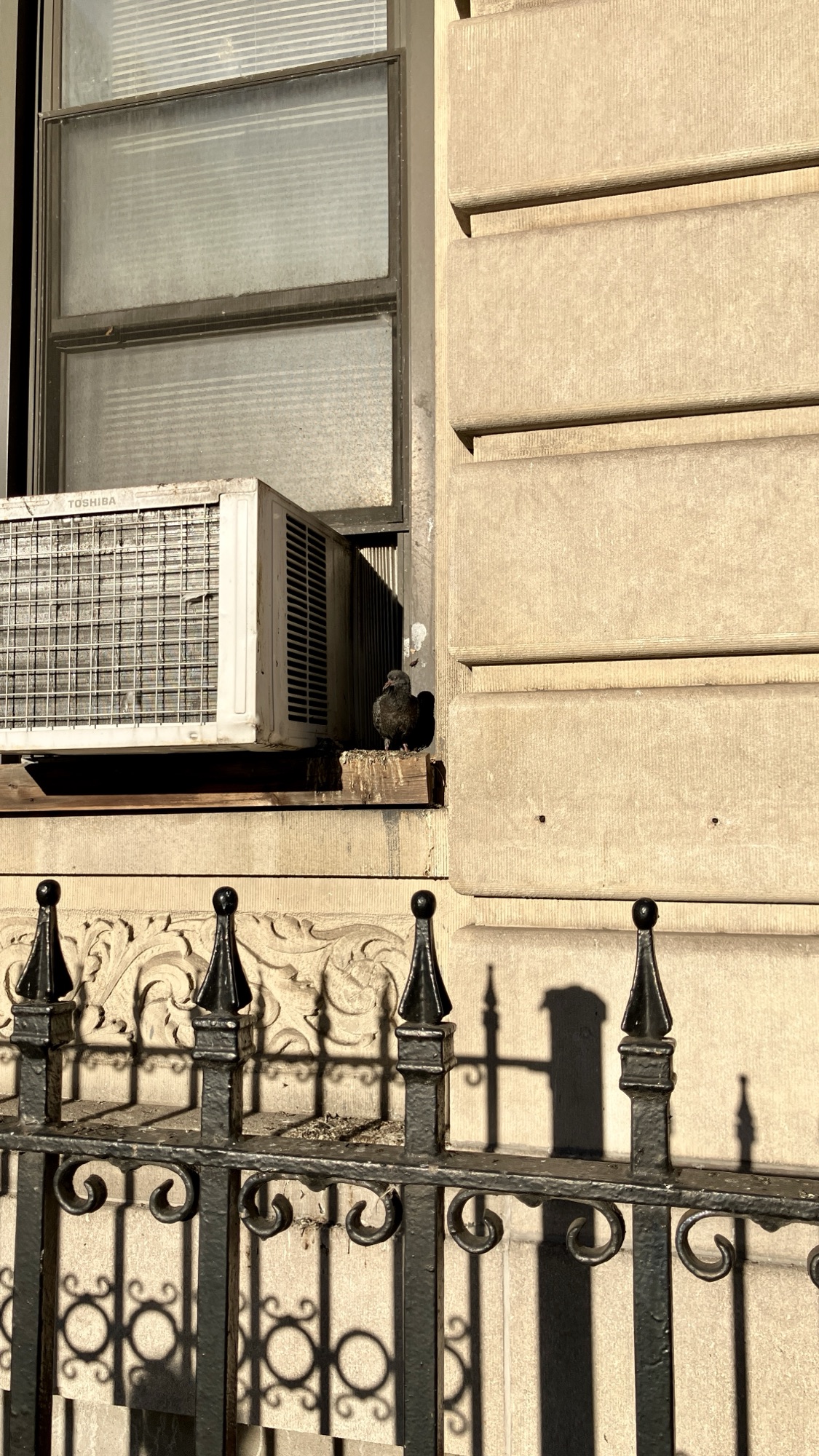
To me, it seems my friend was wrong. I have seen many squab and we have our eyes on a number of nesting mothers as spring emerges. Others have also remarked in this way when we share our urban nature adventures – about the rarity of seeing baby pigeons. Was there a documentary that I missed?
In wondering through this alongside our growing curiosity about our many squab sightings, I initially concluded that people just don’t look around them. This seems certain, in a city of millions who walk around with necks craned into glowing phones. But with more reflection, I think people just rarely walk the same way. There is a certain hurried spontaneity that is the culture here – walking as the lights change, never stepping along the same path twice. I lived that way for years in the East Village, always knowing where I was going but never quite knowing where anything was along my way because my way was never the same.
My son and I began walking the same route to school when we lived in Buffalo and he was attending a pre-school in a public school on the Westside near our home. After a few months of random wandering, we found a way that we liked the most and walked it almost exactly every morning and afternoon. I wanted to instill in him a sense of understanding of his surroundings, but I also wanted to see what we might find with repeat views. We soon learned the houses and found curiosities that never seemed to change – certain cats that we noticed in the same place, dogs to avoid, and neighbors who came to know us by sight and eventually in growing snippets of conversation. We noticed the shape of trees and toys that seemed to wander between blocks, and talked about new trash or graffiti that appeared in our path. After a year of this, it felt a bit like walking anthropology, like we developed an odd expertise in the path we set upon every day and its subtle shifts.
We brought this habit back here to the city, and stick to it for our at least our morning commute. Our walk down squab row is really an uphill block and a half on Park Avenue where the Metro North trains first go under Manhattan, past a plumbing supply store and medical offices in brick buildings with elaborate decorative details. We exchange sports sentiments with a group of young doormen right before we turn east down a block of historic row houses that often sport seasonal decorations similar to the ones my neighbors in Buffalo stuffed their front lawns with each year. The cadence of our walk doesn’t shift much, and I never feel like the lights we stand and wait for keep us from anything noticeably important.
This commitment to something consistent feels important here as much as it did there. I like feeling and knowing the rhythm of blocks and the familiarity that allows us to name things (e.g., the house with the funny window or the Bills guys). I like stubbornly waiting for the lights to turn while others rush past to the opposite crosswalk or move into the intersection anyway. I like seeing things – like squabs – that are apparently not ever seen. Makes me wonder what else I might notice if I slowed down and set my path even more intentionally here in this bustling place.
 Amanda Joy Anderson